

The International Rescue Committee (IRC) Atlanta serves refugees and displaced individuals rebuilding their lives in the U.S. after experiencing the world's worst humanitarian crises. In this transition, refugee families continue to face challenges that threaten their mental and physical wellbeing and limited resources, often having to make difficult choices that affect their health. These communities face complex food insecurity that goes beyond simple access- they need fresh, nutritious food that honors their cultural traditions while supporting their journey toward self-sufficiency.


The Design Intervention
EveryTable is a strategic, community-centered initiative designed to enhance IRC's capacity to provide fresh, nutritious and culturally-inclusive food. This program ensures that food distribution meets immediate and long-term needs to their clients through strategic and efficient processes, collaborative partnerships and adaptive planning. Beyond addressing food insecurity, this systems strengthens community resilience by fostering local partnerships, engages volunteers and staff and equips clients with resources to achieve self-sufficiency in the long run.
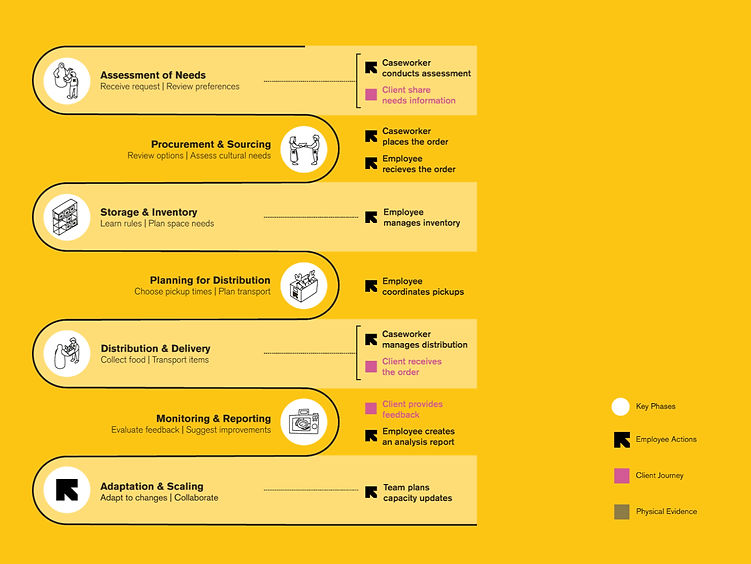
As a holistic system, EveryTable begins with understanding community needs and ends with continuous improvement. Each step is crucial for the next, ensuring fresh food reaches those who need it efficiently. It begins with the assessment stage to establish the foundation of EveryTable, identifying requirements and procurement protocol. In addition, proper storage maintains food quality before distribution planning optimizes logistics. The actual distribution model delivers the food to clients, while monitoring captures performance metrics. Finally, adaptation ensures the system evolves to meet changing circumstances and needs. This approach helps create a responsive system that can scale and adapt to serve communities better over time.
Additionally, EveryTable recognizes the multiple, interconnected network of stakeholders in and around the Atlanta area that belong in the food distribution ecosystem. By mapping the dynamic set of stakeholders involved, the IRC will gain insights into how changes in one area trigger ripple effects throughout the entire network. It also helps highlight critical pathways, potential bottlenecks and anticipate unintended consequences before implementation. EveryTable's ecosystem mapping is vital to illuminate capacity (volunteers, staff and technology) that will help strengthen IRC's programs and expand their current systemic capabilities.
At its core, EveryTable positions itself as a streamlined approach to sourcing, storage and distribution that minimizes waste, improves logistical coordination and enhances service delivery.
Impact
EveryTable strengthens IRC’s ability to deliver fresh, nutritious, and culturally inclusive food to communities in need by transforming food distribution into a coordinated, adaptive system. By aligning procurement, storage, logistics, and distribution processes, the initiative reduces waste, improves operational efficiency, and ensures that food reaches clients reliably and at scale.
Through ecosystem mapping and stakeholder collaboration across the Atlanta food network, EveryTable highlights key partnerships, resources, and capacity gaps, enabling the IRC to make more informed decisions and anticipate system-wide ripple effects. This systems-level approach helps optimize volunteer engagement, strengthen local partnerships, and improve coordination across the food distribution ecosystem.
Beyond immediate food access, EveryTable builds long-term community resilience by creating a responsive framework that continuously learns and adapts. By combining data monitoring, feedback loops, and strategic planning, the system equips IRC to evolve alongside community needs—supporting not only food security today but pathways toward greater self-sufficiency for clients in the future.